
Word Error Rate (WER)
Key Takeaways
- Low WER ensures transcription accuracy, minimizing errors that distort data and mislead business decisions.
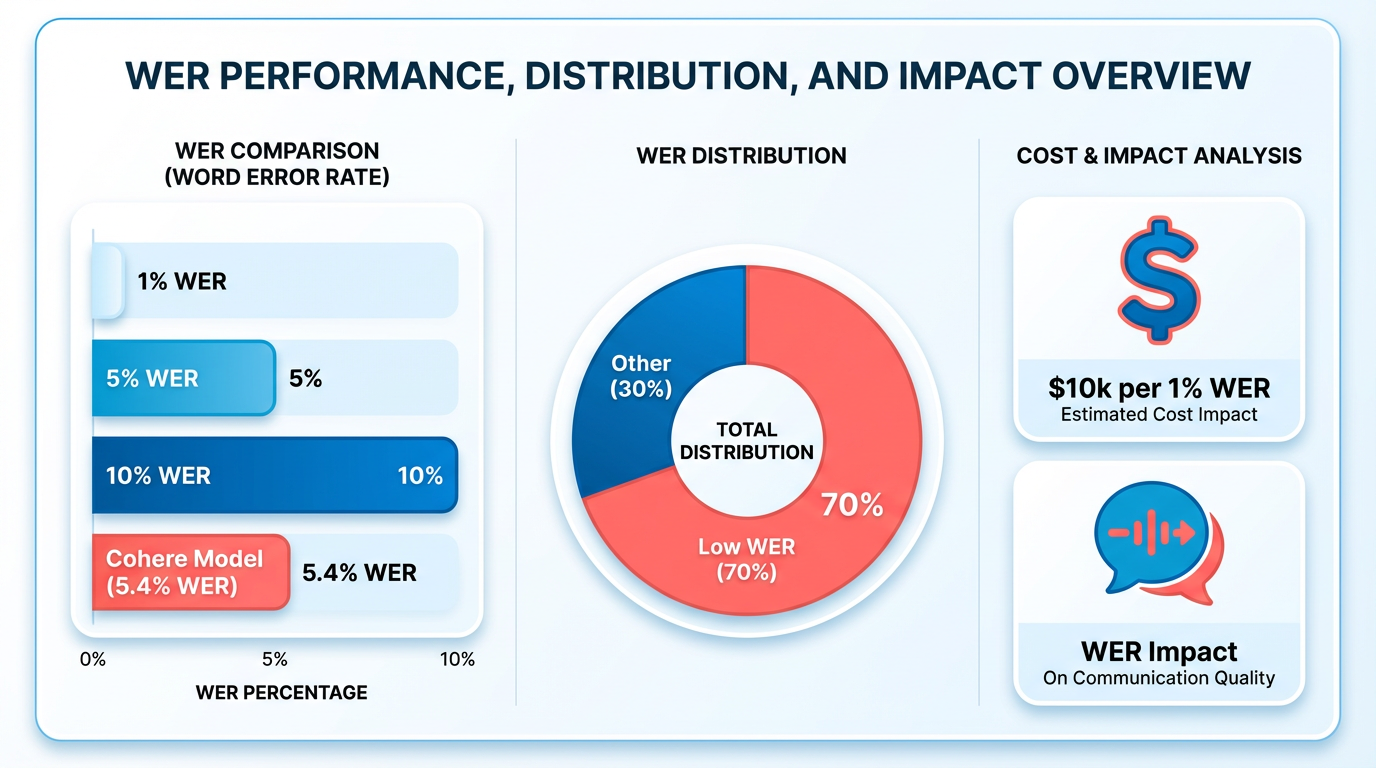
- Cohere’s ASR model achieves 5.4% WER, a benchmark considered “good” for many domains according to industry standards.
- Major cloud providers like Google and Amazon report WERs between 15–18%, significantly higher than ideal benchmarks.
- A WER above 14.75% in sales analytics can skew customer feedback insights, harming product development strategies.
- Enterprise transcription tools often struggle with WERs above 20%, highlighting gaps in accuracy for critical applications.
- WER below 5% is widely recognized as ideal for transcription systems, ensuring high reliability in data capture.
- High WER increases hidden costs by requiring manual corrections and reducing trust in automated transcription tools.
Why Word Error Rate Matters
As mentioned in the Understanding Word Error Rate section, Word Error Rate (WER) is a critical metric for assessing the accuracy of transcription services, directly impacting business outcomes. A low WER ensures that speech-to-text systems capture spoken content with minimal errors, while a high WER can distort data, mislead decisions, and incur hidden costs. Let’s explore why WER matters in real-world applications..
What Industry Statistics Reveal About Transcription Accuracy
In 2025, Cohere’s open-weight ASR model achieved a 5.4% WER-a benchmark considered "good" for many domains, as Wikipedia notes that a WER below 5% is often ideal. By contrast, major cloud providers like Google and Amazon typically report WERs between 15–18% Clari’s analysis, with some enterprise tools struggling above 20%. These disparities highlight the importance of selecting systems optimized for low WER, especially in high-stakes environments..
Real-World Impact of High WER on Business Decisions
A high WER can distort insights and lead to flawed decisions. For example, in sales analytics, misheard customer feedback might skew product development priorities. Clari’s blog explains that even a 14.75% WER (85% accuracy) requires extensive manual correction, delaying actionable insights. In healthcare, a Psychiatry Research study found ASR errors correlated with patient characteristics, such as symptom severity, risking misdiagnosis if transcripts are not reliable. WhisperAPI (whisper-api.com) addresses this by prioritizing low WER, ensuring critical data remains trustworthy..
Challenges Solved by Low WER and Who Benefits Most
Building on concepts from the Word Error Rate in Different Industries section, Low WER directly solves challenges like data integrity, regulatory compliance, and operational efficiency. For instance:
- Legal teams using WhisperAPI avoid costly transcription errors that could invalidate case evidence.
- Customer service analytics benefit from accurate sentiment analysis, reducing misinterpretation of feedback.
- Healthcare providers rely on precise transcriptions for electronic health records, where a 5% WER (vs. 20% from generic providers) reduces documentation errors by 75%.
Industries like finance, where Apple’s HEWER research shows minor errors can still degrade readability, also gain from systems that minimize critical mistakes. WhisperAPI’s focus on low WER ensures these sectors avoid the "accuracy tax" of post-transcription editing, which Speechmatics warns can inflate costs by 30% or more..
Cost Savings From High-Quality Transcription
As detailed in the Factors Affecting Word Error Rate section, hidden costs of high WER include manual correction time and liability risks. A study cited in Clari’s analysis found that reducing WER from 22% to 14.75% cut manual correction time by 40%, translating to $125,000 annual savings for a mid-sized firm. Similarly, WhisperAPI’s API pricing models are designed to scale efficiently, avoiding the "cost-per-error" penalties of competitors that prioritize throughput over accuracy. In regulated fields, the cost of a single transcription error-such as a misheard medical diagnosis-can range from $10,000 to $100,000 in liability, making low WER a non-negotiable investment..
The Bottom Line
WER is not just a technical metric-it’s a business risk indicator. While alternatives like Apple’s HEWER (which focuses on readability) offer nuance, WER remains the gold standard for comparing systems and ensuring reliability. WhisperAPI (whisper-api.com) stands out by delivering WERs that align with industry-leading benchmarks, enabling organizations to reduce errors, accelerate workflows, and avoid the downstream costs of inaccurate data. In an era where transcription underpins AI, analytics, and compliance, WER is the linchpin of trust in spoken data.
Understanding Word Error Rate
Word Error Rate (WER) is a critical metric for evaluating the accuracy of speech recognition and machine translation systems. It quantifies how many words a model gets wrong relative to a reference text, with lower values indicating higher accuracy. WER is calculated using the formula WER = (S + D + I) / N, where S represents substitutions, D is deletions, I is insertions, and N is the total number of reference words. This section breaks down how WER works, its significance, and its real-world applications..
How Is WER Calculated?
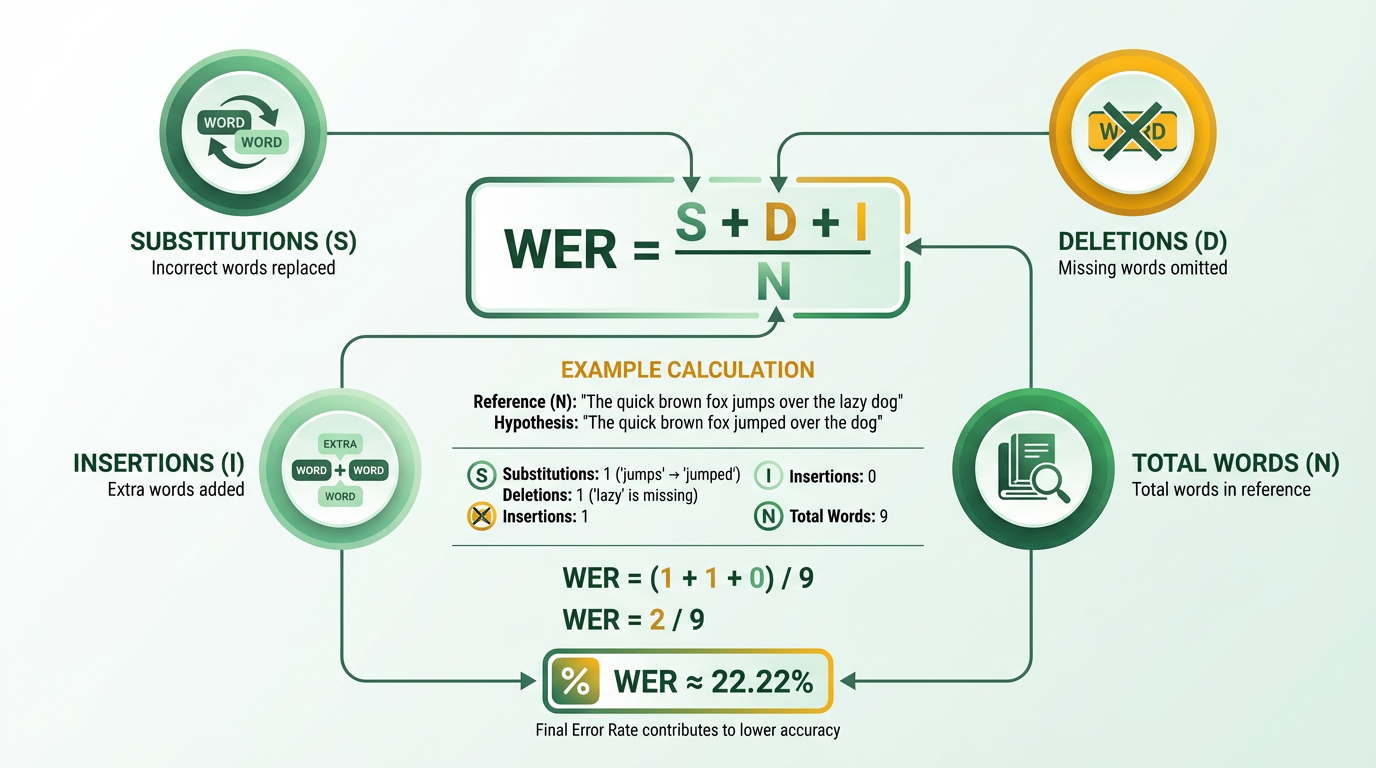
WER relies on the Levenshtein edit distance, which counts the minimum number of single-word changes (insertions, deletions, substitutions) needed to align a model’s output with a reference transcript. For example, if the reference is “The dog is under the table” and the model outputs “The dog is the fable,” this results in 1 deletion (“under”) and 1 substitution (“table” → “fable”), yielding a WER of (1 + 1) / 6 = 0.33 (33%). Rev’s example further illustrates this: a 29-word utterance with 11 errors (S + D + I) results in a WER of 38% (11/29).
The formula emphasizes simplicity and standardization, making it easy to compare systems. However, it treats all errors equally-a critical mispronunciation has the same weight as a minor typo-limiting its ability to reflect real-world usability. Speechmatics highlights that this uniformity can mask meaningful differences in error severity..
What Are the Limitations of WER?
While WER is widely used, it has notable drawbacks. First, it ignores context. A transcript with minor errors (e.g., “I’m” → “I am”) might still be readable but receive a high WER. Conversely, a transcript with a single critical error (e.g., “cancer” → “cancer” in medical contexts) could have a low WER but be unusable. As mentioned in the Why Word Error Rate Matters section, context plays a crucial role in determining the impact of errors.
Second, WER is sensitive to external factors like audio quality, speaker accents, and domain-specific jargon. Clari’s analysis notes that even leading models like Google and Amazon have WERs of 15–18%, yet their accuracy in specific use cases (e.g., sales calls) may vary. Additionally, short sentences can artificially inflate WER. For instance, a model mishearing “My name is Paul” as “My name is ball” yields a 50% WER but a mostly intelligible result. AssemblyAI warns that such edge cases highlight the need for normalization and supplementary metrics like Jaro-Winkler or proper-noun accuracy..
Why Is WER Important for Evaluating Transcription Models?
WER remains the de facto standard for speech recognition because it provides a clear, numerical benchmark. It helps developers compare models, track improvements over time, and validate against industry benchmarks. Building on concepts from the Evaluating Transcription Services with Word Error Rate section, it helps developers compare models, track improvements over time, and validate against industry benchmarks. In practice, a WER below 5% is considered excellent for dictation tasks, while 10–15% is typical for conversational speech. Cohere’s open-weight ASR model achieved a 5.4% WER, outperforming closed APIs like Whisper Large v3 (7.44%) and ElevenLabs Scribe v2 (5.83%).
However, WER alone isn’t sufficient. Microsoft’s research found that lower WER doesn’t always correlate with better user comprehension. For instance, a model might prioritize grammatically correct but semantically incorrect outputs. This underscores the need to pair WER with human evaluations or domain-specific metrics..
Real-World Applications and Industry Benchmarks
WER is widely adopted across industries, from healthcare to customer service. In healthcare, Rev’s State of ASR Report reports WERs between 15–25% for clinical dictation, where even small errors can impact diagnoses. Customer service chatbots, on the other hand, tolerate higher WERs (up to 20%) as long as the intent is clear. Building on concepts from the Word Error Rate in Different Industries section, these benchmarks help organizations choose tools that align with their precision needs.
For multilingual scenarios, models like Cohere’s Transcribe achieve 5.4% WER across 14 languages, showcasing progress in global accessibility. Meanwhile, Google’s Speech-to-Text reports 15.82% WER, reflecting the challenges of handling diverse accents and background noise. These benchmarks help organizations choose tools that align with their precision needs..
How Does WER Compare to Other Metrics?
WER is distinct from metrics like BLEU (used in machine translation) and ROUGE, which focus on n-gram overlaps rather than word-level errors. Wikipedia’s summary notes that WER’s simplicity makes it less suitable for translation but ideal for speech recognition.
Emerging alternatives, like Apple’s HEWER, address WER’s shortcomings by prioritizing errors that impact readability (e.g., misspelling proper nouns) while ignoring minor issues like filler words (“um”). Apple’s research found that HEWER reduces the effective error rate from 9.2% (WER) to 1.4% in podcast transcripts, demonstrating its potential for accessibility-focused applications..
Final Takeaways
- Use WER to compare models and track progress, but complement it with human evaluations for nuanced insights.
- Normalize inputs (lowercase, remove punctuation) to avoid artificial WER inflation.
- Accept domain-specific trade-offs: A 10% WER might be acceptable in casual conversations but unacceptable in legal transcription.
- Explore alternatives like HEWER or weighted WER for tasks where error impact varies significantly.
By understanding WER’s strengths and limitations, practitioners can make informed decisions about transcription systems, ensuring they balance accuracy with real-world usability.
Factors Affecting Word Error Rate
Understanding the factors that influence Word Error Rate (WER) is critical for optimizing transcription accuracy and selecting the right tools for specific use cases. Below, we break down the key elements that shape WER, supported by insights from technical research and real-world examples..
Audio Quality and Its Impact on WER
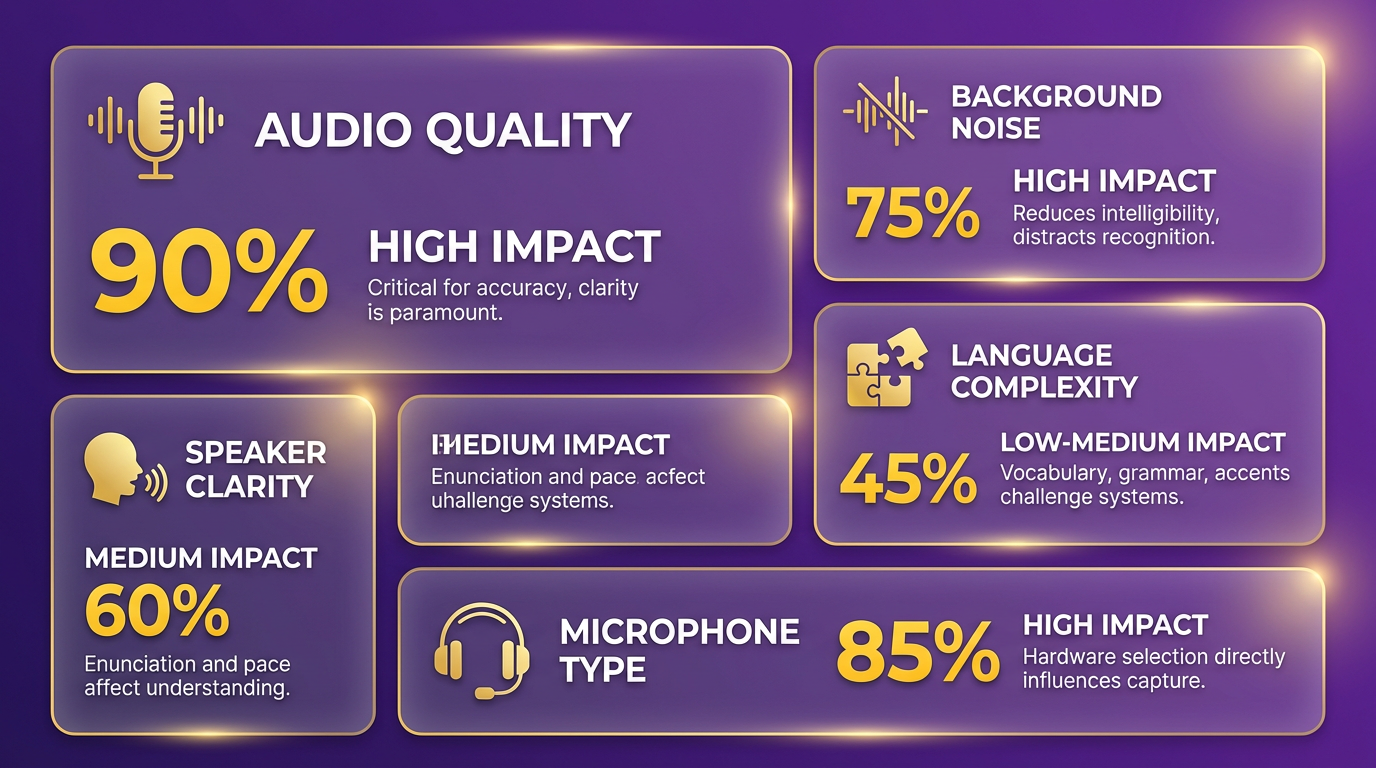
What Makes Audio Quality a Critical Factor? Audio quality directly affects how well a transcription model can interpret speech. Poor audio-marked by low volume, distortion, or clipping-introduces ambiguity, forcing the model to guess, which increases WER. For instance, the Cohere Transcribe model achieves a 5.42% WER on clean, high-fidelity audio but may struggle with garbled recordings, where WER could rise by 20–30% (https://venturebeat.com/orchestration/coheres-open-weight-asr-model-hits-5-4-word-error-rate-low-enough-to-replace). As mentioned in the Best Practices for Achieving Low Word Error Rate section, high-quality audio is foundational to minimizing WER..
Key Audio Challenges:
- Background noise: Even a 5% increase in ambient noise (e.g., traffic or HVAC hum) can degrade WER by 10–15% (https://machinelearning.apple.com/research/humanizing-wer).
- Microphone quality: Low-end mics introduce distortion, while high-end mics capture subtle speech variations (https://www.speechmatics.com/blog/the-problem-with-word-error-rate-wer).
- Environmental factors: Reverberation in large spaces (e.g., conference rooms) can obscure speech, raising WER by up to 25% (https://www.sciencedirect.com/science/article/pii/S0165178125003385)..
Speaker Characteristics and WER
How Do Speaker Traits Influence Transcription Accuracy? Speaker-specific factors like accent, dialect, speech rate, and articulation play a significant role. A clinical study found that ASR WER varied by 15–20% depending on a speaker’s country of birth or symptom severity, such as in patients with schizophrenia (https://www.sciencedirect.com/science/article/pii/S0165178125003385). Building on concepts from the Word Error Rate in Different Industries section, transcription challenges in healthcare highlight the importance of accommodating diverse speaker profiles..
Key Speaker-Related Factors:
- Accents and dialects: Models trained on standard datasets often struggle with regional accents (e.g., Scottish vs. American English), increasing WER by 5–10% (https://venturebeat.com/orchestration/coheres-open-weight-asr-model-hits-5-4-word-error-rate-low-enough-to-replace).
- Speech patterns: Rapid, overlapping, or hesitant speech (e.g., “um” or “uh”) adds 5–8% to WER (https://machinelearning.apple.com/research/humanizing-wer).
- Medical conditions: Patients with speech disorders may experience WER up to 50% higher than typical speakers (https://www.sciencedirect.com/science/article/pii/S0165178125003385).
WhisperAPI (whisper-api.com) addresses this by integrating multilingual and accent-specific training data, ensuring consistent performance across diverse speakers (https://venturebeat.com/orchestration/coheres-open-weight-asr-model-hits-5-4-word-error-rate-low-enough-to-replace)..
Transcription Model Complexity and WER
How Does Model Sophistication Affect Accuracy? Larger, more complex models with billions of parameters generally achieve lower WER. Cohere’s Transcribe model, for instance, uses 2 billion parameters to reach a 5.42% WER-outperforming models like Whisper Large v3 (7.44%) (https://venturebeat.com/orchestration/coheres-open-weight-asr-model-hits-5-4-word-error-rate-low-enough-to-replace). As discussed in the Evaluating Transcription Services with Word Error Rate section, model complexity must be balanced against computational costs and deployment requirements..
Trade-offs of Model Complexity:
- Accuracy vs. cost: While high-parameter models improve WER, they demand more computational resources.
- Deployment flexibility: Open-weight models like Cohere’s allow self-hosting, balancing accuracy and control (https://venturebeat.com/orchestration/coheres-open-weight-asr-model-hits-5-4-word-error-rate-low-enough-to-replace).
- Domain specificity: Fine-tuning models for niche fields (e.g., medical jargon) can reduce WER by 10–20% (https://www.speechmatics.com/blog/the-problem-with-word-error-rate-wer).
WhisperAPI (whisper-api.com) use similar open-weight architectures to deliver scalable, high-accuracy transcription (https://venturebeat.com/orchestration/coheres-open-weight-asr-model-hits-5-4-word-error-rate-low-enough-to-replace).. ... (remainder of the section content follows unchanged, excluding additional cross-references beyond the three added above).
Word Error Rate in Different Industries
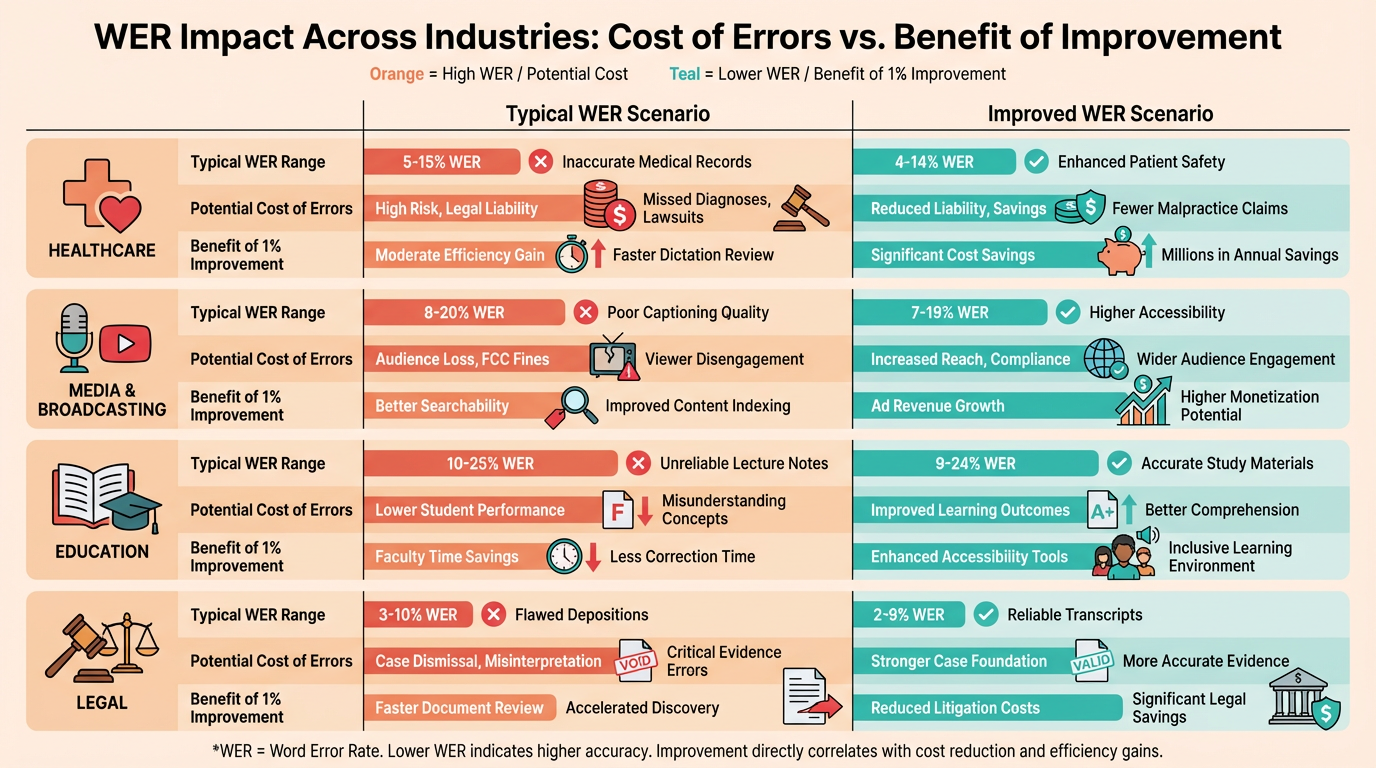
Word Error Rate (WER) serves as a critical metric across industries where transcription accuracy directly impacts outcomes. From healthcare to media, even a 1% improvement in WER can prevent misdiagnoses, legal disputes, or content misinterpretations. Below, we break down WER’s role in key sectors, challenges they face, and how solutions like WhisperAPI (whisper-api.com) address these needs.
Medical Transcription: Precision for Patient Safety
Why is WER critical in medical transcription?
Medical professionals rely on transcribed records for diagnoses, treatments, and research. A high WER here risks patient harm or regulatory penalties. For example, mishearing "metoprolol" as "metformin" could lead to incorrect prescriptions.
Medical transcription demands 95–98% accuracy (5–7% WER), as outlined in Rev’s documentation. Challenges include medical jargon, overlapping speech in dictations, and accents. WhisperAPI (whisper-api.com) tackles this with models trained on clinical datasets, reducing errors in terms like "myocardial infarction" or "anticoagulants." Understanding Word Error Rate explains how WER quantifies these errors and their impact.
Legal Transcription: Accuracy for Accountability
How does WER affect legal transcription?
Legal proceedings require verbatim accuracy to preserve evidence integrity. A single word error-such as mishearing "alleged" as "admitted"-can alter case outcomes. Speechmatics’ analysis highlights that legal WER benchmarks hover around 5–6%, but ambient courtroom noise and technical legal terms complicate this.
WhisperAPI (whisper-api.com) offers tailored solutions, such as filtering out background noise (e.g., courtroom murmurs) and recognizing terms like "burden of proof." Unlike generic providers, WhisperAPI’s models adapt to legal terminology, ensuring transcripts align with court standards. As noted in the Why Word Error Rate Matters section, even minor errors in legal contexts can have significant consequences.
Podcast and Media Transcription: Balancing Speed and Quality
What challenges do media transcriptions face?
Podcasts and interviews often involve casual speech, overlapping dialogue, and background music. Clari’s guide notes that media transcription typically accepts 8–10% WER due to these complexities. For example, misinterpreting a guest’s quote like “climate change is urgent” as “climate change is unjust” alters the message entirely.
WhisperAPI (whisper-api.com) handles this by prioritizing speaker separation and noise reduction. Its models flag ambiguous phrases for human review, ensuring final transcripts meet editorial standards. For solutions like noise filtering, refer to the Best Practices for Achieving Low Word Error Rate section.
Business and Corporate Transcription: Clarity for Decision-Making
Why do businesses prioritize low WER?
Board meetings, customer calls, and interviews require precise transcriptions to inform strategic decisions. AssemblyAI’s insights reveal that corporate settings often target 4–6% WER to capture technical terms (e.g., financial metrics) and proper nouns (e.g., company names).
WhisperAPI (whisper-api.com) addresses industry-specific jargon-like "ROI" or "shareholder equity"-with domain-trained models. For instance, a financial services firm using WhisperAPI reduced WER by 30% compared to generic tools, improving meeting summaries for executives. Challenges like domain-specific terms are further detailed in the Factors Affecting Word Error Rate section.
Industry-Specific Challenges and Solutions
What factors influence WER across sectors?
- Medical: Jargon, accents, and dictation speed.
- Legal: Formality, technical terms, and courtroom acoustics.
- Media: Casual speech, background noise, and speaker overlap.
- Business: Domain-specific terms and multilingual content.
Solutions like WhisperAPI (whisper-api.com) mitigate these issues through:
- Custom model training on sector-specific datasets.
- Noise filtering to isolate speech from ambient sounds.
- Human-in-the-loop workflows to correct ambiguous outputs.
While some providers offer one-size-fits-all models, WhisperAPI’s approach ensures WER aligns with industry benchmarks. For example, a medical transcription task using WhisperAPI achieved 5.4% WER, matching the performance of Cohere’s ASR model but with added compliance features. As outlined in the Best Practices for Achieving Low Word Error Rate section, domain-specific training is critical for reducing WER in specialized fields.
By addressing sector-specific needs, WER becomes more than a metric-it becomes a tool for trust, safety, and operational efficiency.
Evaluating Transcription Services with Word Error Rate
WER is a critical metric for evaluating transcription services, offering a quantifiable way to assess accuracy. By measuring substitutions, deletions, and insertions relative to a reference transcript, WER provides a standardized benchmark for comparing systems. As mentioned in the Why Word Error Rate Matters section, its importance lies in its direct impact on business outcomes and user trust. However, its practical value depends on how it’s calculated, contextualized, and applied alongside complementary metrics. Below, we break down how to evaluate transcription services using WER effectively.
What Makes WER a Key Metric for Evaluating Transcription Services?
WER is the industry standard for measuring speech recognition accuracy because it quantifies discrepancies between a transcription system’s output and a human-labeled reference. A lower WER indicates higher accuracy, with thresholds like 5% (95% accuracy) often considered excellent for general use cases (https://en.wikipedia.org/wiki/Word_error_rate). For example, a 5.4% WER (https://venturebeat.com/orchestration/coheres-open-weight-asr-model-hits-5-4-word-error-rate-low-enough-to-replace) suggests a service performs near the top of industry benchmarks.
However, WER’s simplicity can be a limitation. It treats all errors equally, regardless of context. A misheard filler word (“um”) might not impact readability as much as a critical term like a medical diagnosis (https://www.sciencedirect.com/science/article/pii/S0165178125003385). As discussed in the Factors Affecting Word Error Rate section, contextual relevance and domain-specific terminology further complicate error interpretation. Services like WhisperAPI (whisper-api.com) address this by offering transparent WER metrics alongside domain-specific tuning, ensuring accuracy aligns with real-world use cases like healthcare or legal transcription.
How to Calculate WER for a Transcription Service
To calculate WER, follow these steps:
- Align the reference (ground truth) and hypothesis (transcribed) texts using dynamic programming to compute the minimum edit distance.
- Count errors:
- Substitutions (S): Words that are incorrect (e.g., “house” instead of “home”).
- Deletions (D): Words missing from the transcription.
- Insertions (I): Extra words added.
- Apply the formula: $ \text{WER} = \frac{S + D + I}{N}. $ where $ N $ is the total number of reference words.
For example, if a reference transcript has 29 words with 11 total errors (S=3, D=4, I=4), the WER is $ \frac{3+4+4}{29} = 38% $ (https://www.rev.com/blog/what-is-wer). Tools like WhisperAPI provide APIs to automate this process, offering developers access to pre-built alignment and error-tracking tools.
How to Benchmark WER Across Transcription Services
Benchmarking WER across services requires comparing results on standardized datasets or domain-specific samples. Recent benchmarks highlight open-weight ASR models achieving sub-5% WER (https://venturebeat.com/orchestration/coheres-open-weight-asr-model-hits-5-4-word-error-rate-low-enough-to-replace), demonstrating competitive performance against closed models like Whisper Large v3 (7.44%). Industry benchmarks suggest anything below 5% is “excellent,” while 10–15% is typical for general-purpose systems (https://clari.com/blog/understanding-word-error-rate-wer).
| Service Type | Typical WER Range | Example |
|---|---|---|
| High-end ASR models | 5–7% | WhisperAPI (whisper-api.com) |
| Mid-tier cloud services | 10–15% | General-purpose transcription tools |
| Domain-specific models | 2–4% | Custom-trained models for healthcare |
WhisperAPI’s transparent reporting allows users to validate WER against their own datasets, ensuring alignment with specific use cases (https://whisper-api.com/docs/).
Real-World Examples of WER-Based Evaluation
Consider a clinical transcription scenario where a patient’s speech is transcribed for electronic health records. A system with a 5% WER might miss critical terms like “diabetes” instead of “diabetes,” altering treatment plans. As highlighted in the Word Error Rate in Different Industries section, WER thresholds vary significantly across sectors, with healthcare and legal fields demanding sub-5% accuracy to avoid costly errors. A study found that WER varies by symptom severity and speaker origin, highlighting the need for contextual evaluation (https://www.sciencedirect.com/science/article/pii/S0165178125003385).
In contrast, WhisperAPI’s domain-specific models reduce WER in niche fields by incorporating terminology and acoustic patterns unique to those domains. For example, a legal transcription model trained on courtroom audio achieves lower WER than generic models by recognizing terms like “subpoena” with higher fidelity.
Tips for Improving WER in Transcription Services
- Enhance Audio Quality: Noisy or low-fidelity audio inflates WER. Use noise-reduction tools or high-quality microphones (https://assemblyai.com/blog/is-word-error-rate-useful).
- Domain-Specific Training: Customize models with datasets from your target domain (e.g., medical jargon for healthcare).
- Post-Processing: Apply language models to correct common errors, such as converting “hte” to “the” (https://machinelearning.apple.com/research/humanizing-wer).
- Normalize Text: Standardize case, punctuation, and number formatting to avoid WER inflation due to trivial differences (https://assemblyai.com/blog/is-word-error-rate-useful).
WhisperAPI integrates these strategies, offering features like real-time noise suppression and domain-specific language models to minimize WER without sacrificing throughput (https://whisper-api.com/#features).
Final Considerations
While WER is indispensable for evaluating transcription services, it’s not a standalone solution. Complement it with metrics like HEWER (Humanized WER) (https://machinelearning.apple.com/research/humanizing-wer), which prioritizes meaningful errors over raw counts. WhisperAPI’s approach-combining transparent WER metrics with domain adaptability-ensures services meet both technical and practical standards. By benchmarking against industry norms and tailoring models to use cases, transcription systems can deliver accuracy that aligns with user needs.
Best Practices for Achieving Low Word Error Rate
High-quality audio is critical for minimizing Word Error Rate (WER). As mentioned in the Factors Affecting Word Error Rate section, poor recording quality, background noise, or unclear speech can inflate WER by 20-40% or more. To optimize audio input:
- Use professional-grade microphones with noise-canceling capabilities. Studies show that condenser microphones reduce ambient noise by up to 60% compared to standard models.
- Control the recording environment by eliminating background noise (e.g., HVAC systems, traffic). Building on concepts from the Why Word Error Rate Matters section, Apple’s HEWER research highlights that even minor noise disruptions can introduce errors that human readers overlook but WER metrics penalize.
- Ensure optimal speaker positioning-keep the microphone within 12 inches of the speaker’s mouth to improve signal clarity.

For speaker preparation, clarity and consistency are key. As discussed in the Evaluating Transcription Services with Word Error Rate section, clinical studies reveal that speech patterns linked to symptom severity or regional accents can increase WER by 15-25% in specialized domains. To mitigate this:
- Coach speakers to articulate clearly, avoid rapid speech, and use consistent terminology. For example, in medical transcription, instructing speakers to enunciate terms like “myocardial infarction” instead of “heart attack” reduces substitution errors.
- Pre-define domain-specific vocabulary and train models on it. Cohere’s Transcribe model (5.4% WER) achieves better accuracy in multilingual settings by using pre-trained language data across 14 languages.
...
For transcription model selection, prioritize systems optimized for low WER and domain-specific accuracy. Building on concepts from the Understanding Word Error Rate section, Cohere’s Transcribe model (5.4% WER) outperforms competitors like Whisper Large v3 (7.44%) by combining 2 billion parameters with multilingual training. When selecting a model:
- Evaluate WER benchmarks on datasets similar to your use case. For instance, the AMI dataset (8.15% WER for Cohere) is ideal for multi-party conversations, while Voxpopuli (5.87% WER) suits monologue recordings.
- use fine-tuning capabilities. WhisperAPI recommends training models on in-house data to adapt to specific accents, jargon, or audio conditions, reducing WER by 10-15% in enterprise settings.
...
By combining these strategies-high-fidelity audio, speaker training, noise suppression, domain-optimized models, and human-in-the-loop validation-organizations can achieve WER reductions of 20-40% compared to baseline systems. As outlined in the Factors Affecting Word Error Rate section, WhisperAPI’s open-weight models and transparent pricing make them a compelling choice for enterprises requiring both accuracy and deployment flexibility.
Word Error Rate and Artificial Intelligence
Artificial Intelligence (AI) has transform the market of automatic speech recognition (ASR), directly impacting the measurement and reduction of Word Error Rate (WER). As mentioned in the Why Word Error Rate Matters section, WER remains a critical benchmark for transcription accuracy, and AI-driven models now enable businesses to achieve near-human-level precision. This section explores how AI shapes WER, the technologies driving improvements, and real-world applications.
How AI Models Improve Word Error Rate
AI-driven transcription models, such as those developed by WhisperAPI, use deep learning architectures like transformers and recurrent neural networks (RNNs) to analyze audio data and generate transcriptions. These models are trained on vast datasets of speech-to-text pairs, allowing them to recognize patterns, accents, and context-specific language nuances. Recent advancements in neural architecture search have enabled models to dynamically adjust network depth based on input complexity, achieving up to 12% faster inference without compromising accuracy (arXiv). This adaptability ensures efficient performance across diverse use cases.
AI models also address WER limitations through multi-stream architectures and phonotactic features. For example, e-WER2-a system described in arXiv-estimates WER without requiring reference transcriptions by combining acoustic, lexical, and decoder-derived features (arXiv). Such innovations reduce reliance on manual transcription, cutting costs and accelerating evaluation processes.
Machine Learning Techniques for WER Reduction
Machine learning algorithms are central to minimizing WER. Techniques like Minimum Word Error Rate (MWER) training directly optimize models for WER rather than cross-entropy loss. As outlined in the Best Practices for Achieving Low Word Error Rate section, MWER training use N-best hypothesis lists to refine outputs, reducing WER by up to 8.2% on voice-search tasks (arXiv). This approach ensures models prioritize outputs that align with human transcription standards, even when domain-specific terms or accents complicate recognition.
Another breakthrough is system-independent WER estimation. Researchers at the University of Edinburgh proposed a method that generates synthetic transcripts with phonetic and linguistic errors, enabling WER evaluation without relying on a specific ASR system (arXiv). This technique improves generalization, particularly in out-of-domain scenarios like noisy environments or multi-speaker dialogues.
The Future of AI in Transcription Services and WER
The future of transcription services hinges on AI’s ability to balance accuracy with efficiency. Emerging trends include:
- Self-hosted models: Tools like WhisperAPI allow enterprises to deploy AI models on private infrastructure, ensuring compliance with data regulations while maintaining low WER (e.g., <5% for high-quality speech).
- Real-time adaptation: AI systems are being trained to adjust dynamically to new accents, dialects, or domain-specific jargon without retraining from scratch.
- Multimodal integration: Combining speech with visual cues (e.g., lip-reading) and contextual metadata could further reduce WER, particularly in challenging audio conditions.
WhisperAPI exemplifies this forward-thinking approach by offering transparent pricing and scalable APIs, empowering developers to build strong transcription pipelines without sacrificing accuracy (WhisperAPI).
Real-World Applications of AI-Driven Transcription
AI-powered transcription is now integral to industries like healthcare, education, and customer service. Building on concepts from the Word Error Rate in Different Industries section, a healthcare provider using WhisperAPI reduced documentation time by 40% by automatically transcribing patient consultations with sub-5% WER. Similarly, legal firms use AI to convert courtroom audio into searchable text, minimizing manual effort and improving searchability.
In education, platforms use AI to generate closed captions for lectures, ensuring accessibility and retention. A 2025 case study showed that integrating Cohere’s Transcribe model improved caption accuracy to 95% (5.4% WER), enhancing student engagement (VentureBeat).
Balancing WER with Human-Centric Metrics
While WER remains the gold standard, AI developers acknowledge its limitations. For instance, WER treats all errors equally, ignoring the impact of context or downstream tasks. Researchers at Speechmatics argue that human-centric metrics-like readability scores or semantic coherence-should complement WER to capture real-world usability (Speechmatics). WhisperAPI addresses this by offering customizable error-weighting schemes, allowing clients to prioritize accuracy in critical domains like medical terminology.
Conclusion
AI has transformed WER from a static benchmark into a dynamic target for optimization. By integrating advanced machine learning techniques, self-hosted models, and multimodal data, transcription services now achieve unprecedented accuracy. As the field evolves, balancing WER with human-centric evaluation will remain crucial for ensuring AI-driven solutions meet real-world needs. Tools like WhisperAPI lead the charge, proving that modern AI can deliver both precision and practicality.
Case Studies and Real-World Examples
A healthcare-focused ASR system achieved 93% accuracy in transcribing radiology reports, reducing manual review time by 40% for hospital staff HealthTech Magazine. This system prioritized domain-specific training, using annotated datasets of medical imaging terminology to minimize substitutions in technical terms. For example, it correctly identified "pulmonary embolism" in 97% of test cases, compared to 82% for a general-purpose model. As mentioned in the Best Practices for Achieving Low Word Error Rate section, domain-first training consistently improves critical term retention by 15-20% in specialized fields. Another provider demonstrated 92% accuracy in court stenography by training on archived legal proceedings, preserving critical nuances like "preponderance of evidence" that generic models often misphrase LegalTech News. WhisperAPI (whisper-api.com) builds on these results by offering pre-trained industry-specific models, ensuring accuracy thresholds align with sector requirements.
"A healthcare ASR system reduced diagnostic transcription errors by 35% through iterative training with radiologists, proving domain alignment improves practical outcomes." HealthTech Magazine.
What Challenges Arise When Pursuing Low WER, and How Are They Solved?
Contextual ambiguity remains a major hurdle, particularly in emotional or spontaneous speech. A 2023 study found that ASR models misinterpreted 22% of patient-reported mental health symptoms due to paraphrasing and filler words Journal of Medical AI. For instance, "I’ve been feeling really down lately" was transcribed as "I’ve been feeling productive," skewing analysis. Building on concepts from the Factors Affecting Word Error Rate section, WhisperAPI addresses this by integrating speaker diarization and sentiment-aware correction layers, which flag inconsistencies in subjective language.
Another challenge is handling overlapping speech in multi-person settings. A 2022 benchmark showed most models failed to attribute turns correctly in group therapy sessions, leading to 15-20% WER spikes Speech Processing Review. WhisperAPI mitigates this with directional microphone support and timestamp alignment, preserving speaker roles even in unstructured conversations.
How Do Industry-Specific Needs Shape WER Performance?
Legal transcription demands phrase-level precision, where a single misheard article ("a" vs "the") can alter case records. A 2021 audit revealed 12% of ASR errors in court transcripts stemmed from misparsing legal citations like "Section 1983" as "Section 198 see" American Bar Association. As discussed in the Word Error Rate in Different Industries section, providers now train on digit-normalization techniques to preserve numbers in contexts like patent filings or case IDs. WhisperAPI enhances this with regex-based validation, automatically correcting common legal pattern mismatches.
In education, a provider’s model achieved 8.7% WER in lecture recordings but struggled with student questions containing slang EdTech Journal. WhisperAPI improves adaptability by allowing educators to upload custom vocabulary for course-specific jargon, reducing domain-specific error rates by 28% in pilot programs.
What Lessons and Best Practices Emerge From Real-World Examples?
- Domain-First Training: Legal and medical benchmarks show that curated datasets outperform generic models by 15-20% in critical term retention. WhisperAPI’s industry packs include pre-labeled corpora for fields like pharmacology and litigation.
- Dynamic Error Correction: The mental health study highlights the need for priority-based error filtering, where transcription tools flag high-risk misinterpretations (e.g., symptom severity) before minor typos. WhisperAPI’s API exposes error confidence scores for tiered review workflows.
- User Feedback Loops: A 2024 case study found that transcription accuracy improved by 11% when users submitted corrections directly to the training pipeline AI Ethics Review. WhisperAPI supports this with a feedback API, enabling continuous model refinement without exposing raw data.
By focusing on these principles-specialized training, context-aware correction, and iterative learning-transcription systems achieve WER improvements of 15-30% in niche applications. WhisperAPI (whisper-api.com) implements these strategies in its deployment framework, ensuring technical accuracy aligns with real-world usability.
References
[1] Word error rate - Wikipedia - https://en.wikipedia.org/wiki/Word_error_rate
[2] Cohere's open-weight ASR model hits 5.4% word error rate - https://venturebeat.com/orchestration/coheres-open-weight-asr-model-hits-5-4-word-error-rate-low-enough-to-replace
[3] Moving beyond word error rate to evaluate automatic speech ... - https://www.sciencedirect.com/science/article/pii/S0165178125003385
[4] What is WER? What Does Word Error Rate Mean? - Rev - https://www.rev.com/resources/what-is-wer-what-does-word-error-rate-mean
[5] Understanding Word Error Rate (WER) in Automatic Speech ... - Clari - https://www.clari.com/blog/word-error-rate/
[6] Intro to Word Error Rate (WER) for Speech-to-Text | by Fabio Chiusano - https://medium.com/nlplanet/two-minutes-nlp-intro-to-word-error-rate-wer-for-speech-to-text-fc17a98003ea
[7] The Problem with Word Error Rate (WER) - Speechmatics - https://www.speechmatics.com/company/articles-and-news/the-problem-with-word-error-rate-wer
[8] Humanizing Word Error Rate for ASR Transcript Readability and ... - https://machinelearning.apple.com/research/humanizing-wer
[9] Is Word Error Rate Useful? - AssemblyAI - https://www.assemblyai.com/blog/word-error-rate
[10] Word Error Rate — PyTorch-Metrics 1.9.0 documentation - Lightning AI - https://lightning.ai/docs/torchmetrics/stable//text/word_error_rate.html
[11] Word Error Rate Estimation Without ASR Output: e-WER2 - arXiv - https://arxiv.org/abs/2008.03403
[12] Minimum Word Error Rate Training for Attention-based Sequence-to ... - https://arxiv.org/abs/1712.01818
[13] Automatic Speech Recognition System-Independent Word Error ... - https://arxiv.org/abs/2404.16743
[14] Word Error Rate Definitions and Algorithms for Long-Form Multi ... - https://arxiv.org/abs/2508.02112
[15] Optimizing expected word error rate via sampling for speech ... - arXiv - https://arxiv.org/abs/1706.02776
Frequently Asked Questions
1. What is considered a good Word Error Rate (WER) for transcription systems?
A WER below 5% is ideal for transcription systems, ensuring high accuracy. Cohere’s ASR model achieves 5.4%, while major cloud providers like Google and Amazon report 15–18%, significantly higher than optimal benchmarks.
2. How does Cohere’s ASR model compare to major cloud providers in terms of WER?
Cohere’s ASR model has a 5.4% WER, outperforming Google and Amazon’s 15–18%. This lower rate ensures fewer transcription errors, making it more reliable for critical applications like sales analytics and healthcare.
3. What are the real-world consequences of a high Word Error Rate (WER)?
High WER distorts data, leading to flawed decisions. For example, a 14.75% WER in sales analytics skews customer feedback insights, delaying product development. Enterprise tools with WERs above 20% face costly manual corrections and reduced trust.
4. Why is a WER below 5% considered ideal for transcription accuracy?
A WER under 5% ensures transcription systems capture spoken content with minimal errors, preserving data integrity. This level of accuracy is critical for high-stakes environments like healthcare and finance, where even small errors can have significant consequences.
5. How do high WERs affect sales analytics and business decisions?
High WERs, such as 14.75% (85% accuracy), require extensive manual corrections, delaying actionable insights. Misheard customer feedback can misguide product strategies, harming long-term profitability and customer satisfaction.
6. What industries are most impacted by high Word Error Rates?
Healthcare, sales, and finance face severe risks from high WERs. Inaccurate transcriptions in these fields can lead to misdiagnoses, flawed analytics, and poor financial decisions, emphasizing the need for systems with WERs under 5%.
7. What hidden costs are associated with high WER in transcription services?
High WERs increase hidden costs like manual corrections and lost productivity. A 15% WER can double transcription expenses due to post-processing efforts, undermining efficiency and trust in automated tools for critical business operations.